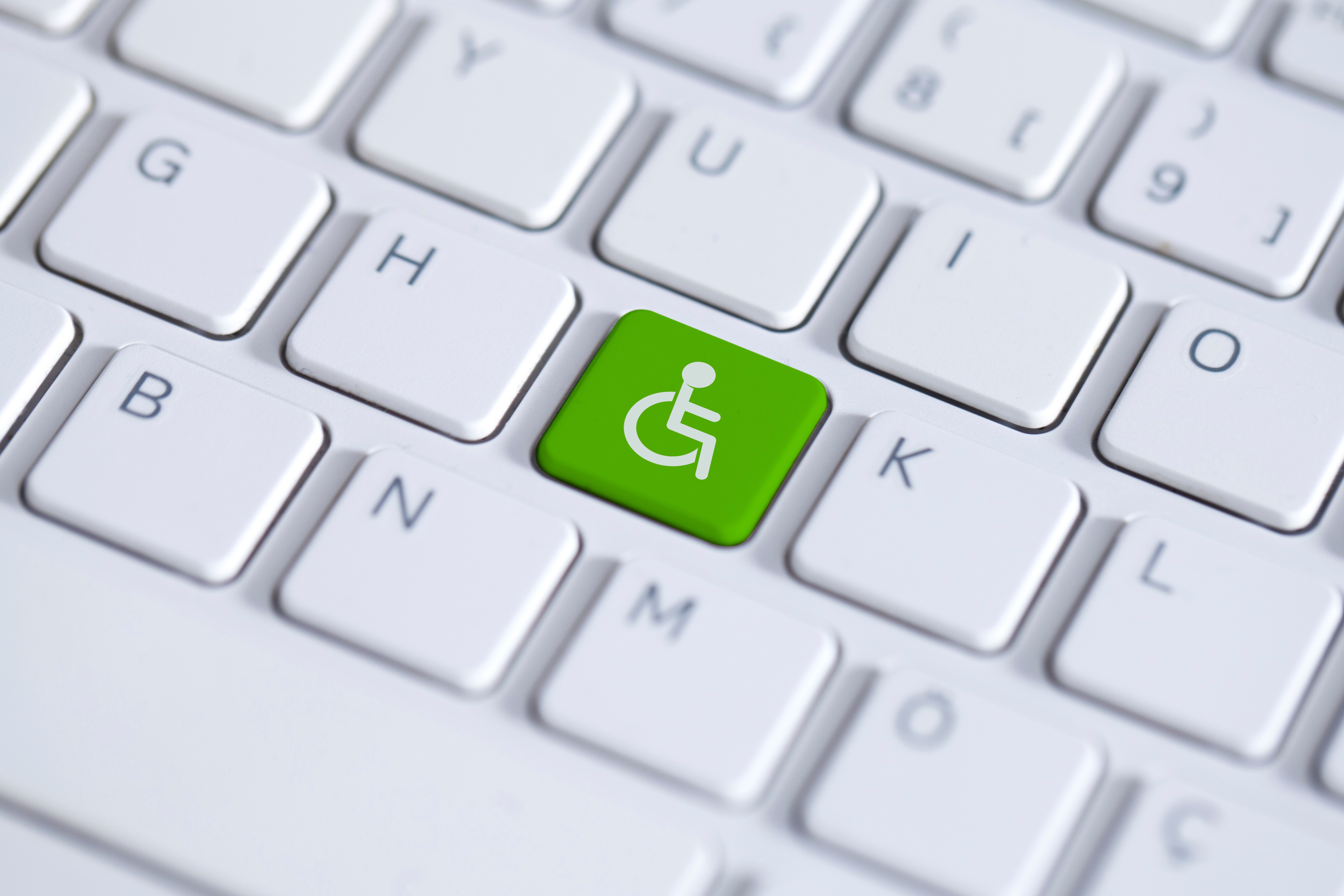
“Good design is accessible design. Anything else is broken.” – Kat Holmes
A legal hurdle: Section 508 accessibility requirements. As someone who first started doing work for government marketing projects, I was introduced to Section 508 accessibility requirements as a legal hurdle—a list of items that we needed to check in order to deliver the work. Alt text, captioning, color contrast testing — it all felt bureaucratic. I’ll be the first to say that, in the beginning, it felt like the enemy of creativity.
But I eventually realized that what I thought were constraints were really principles that make communication actually work for everyone. I’ve rebuilt my government marketing and, in hindsight, my approach to design and advertising in general off that epiphany.
⸻
Lessons from Government Work.
In federal marketing campaigns, accessibility is not something that can be ignored. All those things, including social media ads, PDFs, websites – they all need to meet 508 standards, and that lines up with the WCAG standard globally. Every time we worked on creative, we had to ask questions that so many marketing shops don’t: Would a person using a screen reader hear the whole story? Would our color scheme render text illegible to someone with low vision? Could captions really get our message across to a viewership that might not be able to hear the audio?
These weren’t minor details. They completely changed the way we consider design.
It wasn’t simply to check some box to keep the complaints or audits at bay. It was about communicating clearly. I began to realize that these “restrictions” were actually making us better communicators — they were forcing us to think about clarity, empathy, and usability at every step.
⸻
Accessibility Is Not Optional for Private Sector.
It can be hard for companies — especially those not in the government — to think of accessibility as someone else’s problem. After all, they are not covered by federal law — yet. But here’s the reality: More than a billion people around the world have a disability, reports the World Health Organization. The CDC says that, in the U.S., 1 in 4 adults lives with a disability.
That’s not a niche market. That’s your audience.
And for people who do not have permanent disabilities, accessibility can matter. Think of someone trying to watch your video on a noisy subway without the captions. Or you’re a parent trying to hold a child with one arm while using your app with the other. Or a baby boomer squinting at your small, low-contrast text on a phone.
As Kat Holmes has written in “Mismatch: How Inclusion Shapes Design”: “When we design for disability first, you often stumble upon solutions that are better than those when we design for the norm.” And it is not about serving a minority of the people who use a thing. That’s much more about designing well for everybody.
⸻
Advertising Is About Reaching People.
At its essence, advertising is the investment of being seen and heard. Each dollar spent is designed to send a message. If a message is out of reach for a large number of your potential audience, you’re throwing away money to leave them out.
And that’s not just ethically suspect — it’s bad business.
By running an ad campaign without captions or with poor color contrast, it’s not just people with disabilities who fall through the cracks. It doesn’t work in noisy bars, under bright sunshine, on older devices. Accessible is another means to the best usability in any situation. It expands your reach, which is what advertising is all about in the end.
⸻
There is a Fostering of Trust and Loyalty to the Brand through Accessibility.
Brands that support it demonstrate they care about what their customers care about. In a digital world built on authenticity and social responsibility, overlooking accessibility sends the opposite message: we’re prepared to exclude people in order to save work.
According to a Forrester report from 2022, companies that focus on making their services more accessible to everyone can help them foster a larger customer base, as well as increased customer loyalty. And lawsuits over inaccessible digital experiences are increasing year after year in the U.S., with upwards of 4,000 ADA-related lawsuits filed in 2022 against private companies.
Access is not just a matter of avoiding trouble with the law. It’s about lining your brand up with inclusion, empathy, and forward-thinking values that people actually care about.
⸻
Constraints Lead to Better Creativity.
But some worry that accessibility could dilute their creative vision. My career in government marketing has shown me the opposite.
Designing for accessibility didn’t hold us back, it made us more clever. We minimized layouts to minimize cognitive load. We selected color palettes that everyone could work with. We wrote clearer copy. We included those captions, which even users without hearing impairments watched for higher engagement.
Rather than making our work boring, it made our work productive.
⸻
A Call to Action for Brands.
If you’re not stifled by Section 508 regulations, then you probably don’t think you need to be concerned with accessibility. But you do — because good design is inclusive design. Your marketing isn’t done until people with disabilities can access it. If your ads shut out potential customers, you’re wasting money.
Accessibility is not a burden. It’s a design ethic. It’s a competitive advantage. And above all, it’s a pledge to do what design is meant to do: communicate, clearly, meaningfully, universally.
If you’re ready to elevate your brand’s design, start asking the painfully difficult questions that government projects make you ask. Who might be left out? How can we fix that? Because the future of design is not only inclusive, it’s something everyone should aspire to wrap their brains around as quickly as possible.
References.
Centers for Disease Control and Prevention. (2023). Disability impacts all of us. Retrieved from https://www.cdc.gov/ncbddd/disabilityandhealth/impacts/us.html
Forrester Research. (2022). The business case for digital accessibility. Forrester Consulting. Retrieved from https://www.microsoft.com/en-us/accessibility/business-case
Holmes, K. (2018). Mismatch: How inclusion shapes design. MIT Press.
UsableNet. (2023). 2022 ADA digital accessibility lawsuit report. Retrieved from https://blog.usablenet.com/2022-ada-digital-accessibility-lawsuit-report
World Health Organization. (2023). Disability and health. Retrieved from https://www.who.int/news-room/fact-sheets/detail/disability-and-health